Online Trust Registration
Online Trust Registration – An Overview
- Online Trust Registration is the legal process of registering a trust under the relevant state Trust Act in India. A trust is generally formed to carry out charitable, religious, or social welfare activities. Registering a trust provides it with legal recognition and enables it to operate formally, open bank accounts, receive donations, and apply for tax exemptions such as 12A and 80G.
- With digital processes and professional assistance, trust registration has become more streamlined and efficient. Although registration procedures may slightly vary from state to state, the core requirements remain similar across India.
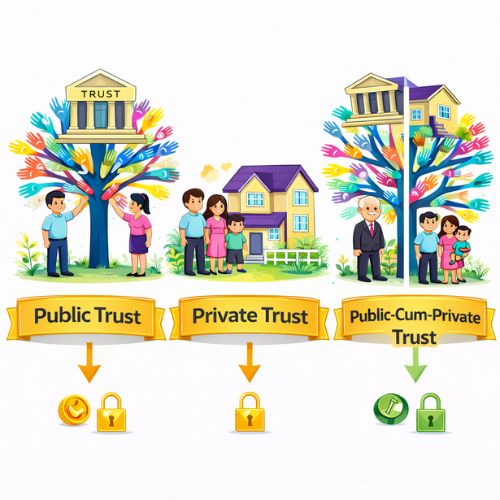
Types of Trusts
Trusts in India are generally classified into the following types:
Public Trust
Formed for public charitable or religious purposes such as education, healthcare, or relief activities.
Private Trust
Created for the benefit of specific individuals or families.
Public-Cum-Private Trust
A combination where benefits are provided to both specific individuals and the public.
Public charitable trusts are most common for NGOs and non-profit organizations.
What is a Trust?
A trust is a legal arrangement where a person (called the settlor) transfers property or assets to another person or group (called trustees) for the benefit of specific individuals or the public.
Settlor
The person who creates the trust
Trustees
Individuals who manage the trust
Beneficiaries
Persons or the public who benefit from the trust
Trusts are commonly formed for charitable, educational, medical, religious, and social welfare purposes.
Documents Required for Trust Registration in India
The following documents are generally required:
- Trust Deed (properly drafted and signed)
- Identity proof of settlor and trustees (Aadhaar, PAN, etc.)
- Address proof of settlor and trustees
- Passport-size photographs
- Registered office address proof
- No Objection Certificate (NOC) from property owner (if applicable)
Proper documentation ensures smooth approval and registration.
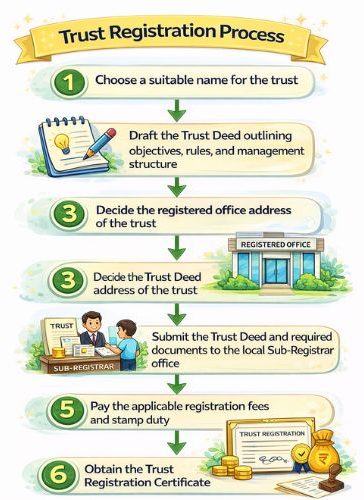
Online Trust Registration Process
The trust registration process generally involves the following steps:
Step 1
Choose a suitable name for the trust.
Step 2
Draft the Trust Deed outlining objectives, rules, and management structure.
Step 3
Decide the registered office address of the trust.
Step 4
Submit the Trust Deed and required documents to the local Sub-Registrar office.
Step 5
Pay the applicable registration fees and stamp duty.
Step 6
Obtain the Trust Registration Certificate.
Once registered, the trust becomes legally recognized and can begin its operations.
Frequently Asked Questions (FAQ's)
VMAAYAN provides complete assistance in drafting the Trust Deed, preparing documents, and completing the trust registration process smoothly and efficiently.
Yes, VMAAYAN supports trusts in applying for 12A and 80G registrations to help them obtain tax exemptions and donor benefits.
You need to provide identity proof, address proof, passport-size photographs of trustees, registered office proof, and other necessary details to VMAAYAN for processing.
VMAAYAN ensures a timely registration process, usually completed within a few weeks depending on state procedures and document verification.
VMAAYAN offers professional guidance, transparent pricing, and end-to-end support, making trust registration simple and hassle-free.