Private Limited Company
The Private Limited Company registration process begins with obtaining a Digital Signature Certificate (DSC) for all proposed directors, as the incorporation documents must be filed online with the Ministry of Corporate Affairs (MCA). Next, the directors must apply for a Director Identification Number (DIN), which serves as a unique identification for individuals intending to become directors of a company. After this, a suitable and unique company name is selected and submitted for approval through the MCA portal.
Once the name is approved, the Memorandum of Association (MOA) and Articles of Association (AOA) are drafted to define the company’s objectives and internal rules. The incorporation application is then filed through the SPICe+ form along with the required documents, including identity and address proofs of directors and registered office proof. After verification, the Registrar of Companies (ROC) issues the Certificate of Incorporation, confirming the legal existence of the company. Upon incorporation, the company receives its PAN and TAN, and a bank account can be opened to commence business operations.

What is a Public Limited Company in India?
A Public Limited Company in India is a type of corporate business structure that allows a company to offer its shares to the public and raise capital from investors. It is registered under the Companies Act and regulated by the Ministry of Corporate Affairs (MCA). A Public Limited Company has a separate legal identity distinct from its shareholders, meaning it can own property, enter into contracts, and operate in its own name. The liability of shareholders is limited to the amount invested in the company, protecting their personal assets from business liabilities. To form a Public Limited Company in India, a minimum of three directors and seven shareholders is required. This structure is generally preferred by businesses aiming for large-scale operations, expansion, and higher credibility in the market, as it provides better access to funding and stronger public trust.
Features of Public Limited Company in India
A Public Limited Company in India has several distinctive features that make it suitable for large-scale businesses and companies planning expansion.
Separate legal entity
A Public Limited Company has its own legal identity separate from its shareholders. It can own assets, enter into contracts, and sue or be sued in its own name.
Limited liability
The liability of shareholders is limited to the amount invested in the company. Their personal assets are protected from business debts and liabilities.
Minimum members requirement
A Public Limited Company requires a minimum of three directors and seven shareholders. There is no limit on the maximum number of shareholders.
Ability to raise capital from the public
The company can issue shares to the public to raise funds, making it easier to generate large capital for expansion and growth.
Regulated structure
It operates under strict compliance and regulatory requirements as per the Companies Act and is monitored .
Higher credibility
Due to regulatory oversight and transparency requirements, Public Limited Companies enjoy higher trust among investors, banks, and the public.
Advantages of a Public Limited Company in India
Easy access to capital
A Public Limited Company can raise large funds from the public by issuing shares, supporting expansion and business growth.
Limited liability protection
Shareholders are liable only to the extent of their investment, protecting personal assets from business debts.
Separate legal entity
The company has its own legal identity and can own property, enter into contracts, and operate independently.
Enhanced credibility
Being regulated under the Companies Act increases transparency and builds trust among investors and financial institutions.
Perpetual succession
The company continues to exist even if there are changes in shareholders or directors.
Better growth opportunities
Access to public investment and stronger market presence supports long-term expansion and scalability.
Requirements for public limited company registration
- Minimum of seven shareholders.
- Minimum of three directors.
- Digital Signature Certificate (DSC) of the proposed directors.
- Director Identification Number (DIN) for all directors.
- A valid registered office address in India.
- Drafting and submission of Memorandum of Association (MoA) and Articles of Association (AoA).
- Filing of incorporation application with the Registrar of Companies (RoC) along with required forms and documents.
- Payment of the prescribed government registration fees to the RoC.
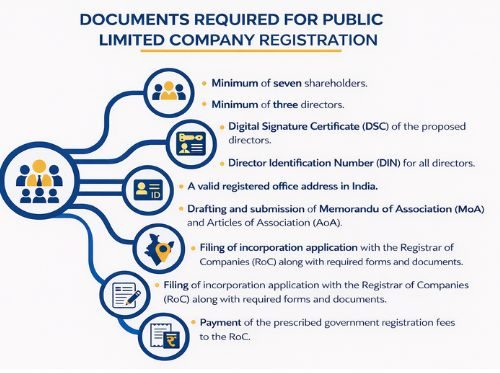
Documents required for incorporation of a public limited company in India
- PAN card of all directors and shareholders (mandatory for Indian nationals).
- Identity proof of directors and shareholders (Aadhaar card, passport, voter ID, or driving license).
- Address proof of directors and shareholders (bank statement, electricity bill, or mobile bill not older than 2 months).
- Passport-size photographs of all directors.
- Registered office address proof (electricity bill, water bill, or property tax receipt not older than 2 months).
- Rent agreement and No Objection Certificate (NOC) from the owner if the registered office is rented.
- Memorandum of Association (MoA) and Articles of Association (AoA).
- Digital Signature Certificate (DSC) of all proposed directors.
- Director Identification Number (DIN) for each director.
- Declaration and consent forms signed by directors and subscribers as required under the Companies Act.
Difference between private and public limited company
| Basis of Comparison | Private Limited Company | Public Limited Company |
|---|---|---|
| Minimum Shareholders | Minimum 2 shareholders | Minimum 7 shareholders |
| Minimum Directors | Minimum 2 directors | Minimum 3 directors |
| Maximum Shareholders | Maximum 200 shareholders | No limit on maximum shareholders |
| Raising Capital | Cannot invite public to subscribe to shares | Can raise capital from the public |
| Transfer of Shares | Transfer of shares is restricted | Shares are freely transferable |
| Compliance Requirements | Lesser compliance requirements | Higher and stricter compliance requirements |
| Listing on Stock Exchange | Cannot be listed on stock exchange | Can be listed on stock exchange (subject to rules) |
| Suitability | Suitable for startups and small businesses | Suitable for large businesses and expansion plans |
Frequently Asked Questions
Vmaayan Tax and Financial Solutions provides complete assistance from name approval and documentation to filing incorporation forms and obtaining the Certificate of Incorporation.
A Public Limited Company requires a minimum of 3 directors and 7 shareholders. Vmaayan guides you through meeting all legal requirements smoothly.
With proper documentation, Vmaayan typically completes the registration process within 10–15 working days, subject to government approval.
Yes, Vmaayan offers ongoing compliance services including annual filings, ROC compliance, tax advisory, and GST registration support.
Vmaayan ensures accurate documentation, transparent pricing, professional guidance, and complete compliance support for a smooth registration process.