Startup Registration
Startup Registration India – An Overview
- Startup Registration in India is the process of legally establishing a new business entity and obtaining recognition under the Government of India’s Startup India initiative. It allows entrepreneurs to operate within a structured legal framework while enjoying various benefits such as tax exemptions, funding support, and ease of compliance.
- A startup can be registered as a Private Limited Company, LLP, or Partnership Firm. After incorporation, eligible businesses can apply for DPIIT (Department for Promotion of Industry and Internal Trade) recognition to avail government benefits. Startup registration helps build credibility, attract investors, and ensure legal protection.
What is Startup Company Registration?
- Startup Company Registration refers to the legal incorporation of a new business entity under Indian law. It involves registering the company with the Ministry of Corporate Affairs (MCA) and obtaining a Certificate of Incorporation.
- Once incorporated, businesses that meet eligibility criteria (such as innovation, scalability, and turnover limits) can apply for Startup India recognition. This recognition provides access to tax benefits, easier compliance norms, and government funding schemes.
In simple terms, startup registration gives your business a legal identity and opens the door to growth opportunities.
Benefits of Startup Registration India
Startup registration offers several advantages:
Legal Recognition
Establishes your business as a recognized legal entity.
Tax Benefits
Eligible startups can apply for tax exemptions under government schemes.
Funding Opportunities
Access to government grants, schemes, and easier funding options.
Intellectual Property Support
Fast-track patent and trademark registration with rebates.
Ease of Compliance
Simplified regulatory procedures under Startup India.
Better Credibility
Enhances trust among investors, banks, and customers.
Checklist for Startup Registration India
Decide the business structure (Private Limited, LLP, or Partnership).
Obtain Digital Signature Certificate (DSC).
Apply for Director Identification Number (DIN) (for companies).
Choose a unique business name.
Prepare identity and address proof of directors/partners.
Provide registered office address proof.
Draft Memorandum and Articles of Association (for companies).
Check eligibility for DPIIT Startup recognition.
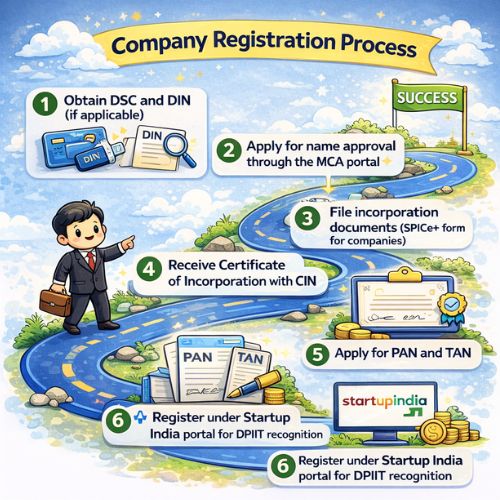
Startup Registration Process
The startup registration process generally includes:
Step 1
Obtain DSC and DIN (if applicable).
Step 2
Apply for name approval through the MCA portal.
Step 3
File incorporation documents (SPICe+ form for companies).
Step 4
Receive Certificate of Incorporation with CIN.
Step 5
Apply for PAN and TAN.
Step 6
Register under Startup India portal for DPIIT recognition.
After approval, the startup becomes eligible for government benefits and schemes.
Frequently Asked Questions (FAQ's)
Businesses incorporated as Private Limited Company, LLP, or Partnership Firm with turnover below the prescribed limit and focused on innovation or scalability are eligible.
No, but it is highly beneficial for availing tax exemptions and government support.
Company incorporation usually takes a few working days, while DPIIT recognition depends on approval timelines.
Yes, if it meets the eligibility criteria under Startup India guidelines.
No, startups must apply separately for tax exemption after obtaining DPIIT recognition.